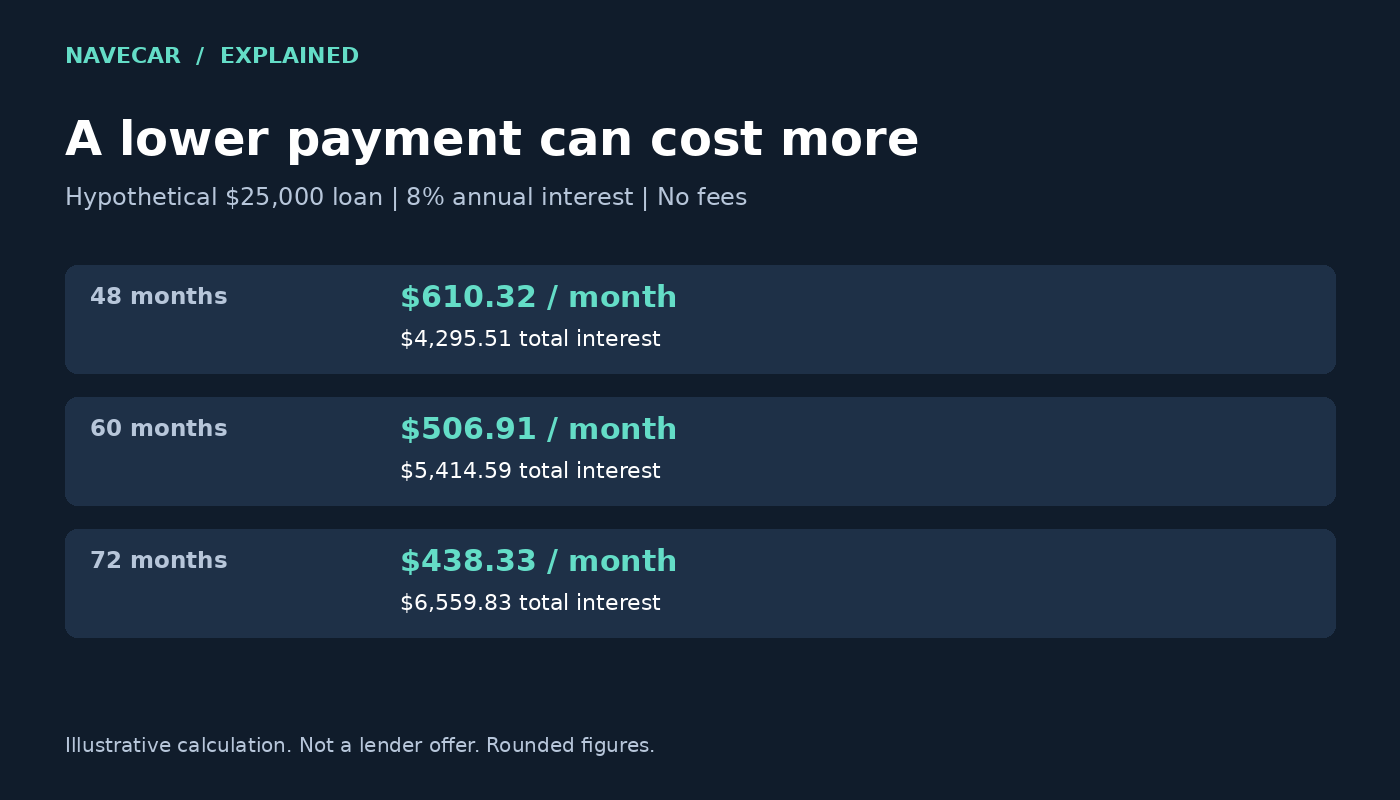
Extending a car loan can make the monthly payment easier to fit into a budget while increasing the amount paid for the same vehicle. In the hypothetical example below, moving from 48 to 72 months cuts the payment by about $172 but adds about $2,264 in interest.
The CFPB’s loan-comparison guidance recommends examining the amount financed, APR, interest rate and term alongside the payment.
The assumptions behind this example
Assume a $30,000 vehicle price, a $5,000 down payment and $25,000 financed. The calculation uses a fixed 8% nominal annual interest rate, divided by 12 for monthly amortization, with equal end-of-month payments. It includes principal and interest only.
Advertisement
Taxes, registration, dealer charges, optional products and lender fees are excluded. The interest rate is an illustrative input, not an available offer or a claim about what a borrower will qualify for. This is not a complete credit-cost quote.
| Term | Monthly payment | Total loan payments | Total interest |
|---|---|---|---|
| 48 months | $610.32 | $29,295.51 | $4,295.51 |
| 60 months | $506.91 | $30,414.59 | $5,414.59 |
| 72 months | $438.33 | $31,559.83 | $6,559.83 |
Totals use unrounded calculations; a lender’s payment rounding and final installment can differ. Add the $5,000 down payment to the loan-payment total to calculate cash paid toward this hypothetical purchase before excluded costs.
What the extra time buys—and costs
The 60-month option reduces the monthly commitment by about $103 compared with 48 months, but adds roughly $1,119 in interest. Extending from 60 to 72 months saves about $69 a month and adds roughly another $1,145 in interest.
These are alternative schedules for the same principal and rate. If an actual lender also raises the rate for a longer term, request a fresh calculation rather than applying these differences to its quote.
Compare like-for-like offers
APR includes applicable credit fees and is broader than the interest rate, as the CFPB’s definitions explain. Compare APR with APR, and check the amount financed rather than assuming identical payments mean identical deals.
Ask each lender for its written terms using the same vehicle, down payment and optional products. Then compare both the monthly obligation and the total repayment. Set aside room for insurance, fuel and maintenance: a manageable loan payment alone does not establish that the whole ownership budget works.