If a car’s loan payoff exceeds its trade-in value, the difference still needs to be paid. Accepting a dealer’s trade-in offer does not make that old debt disappear.
The CFPB advises borrowers to obtain the current payoff amount and compare it with the vehicle’s value before deciding whether to trade. Rolling a shortfall into another loan increases borrowing and financing costs.
Follow the gap through a hypothetical purchase
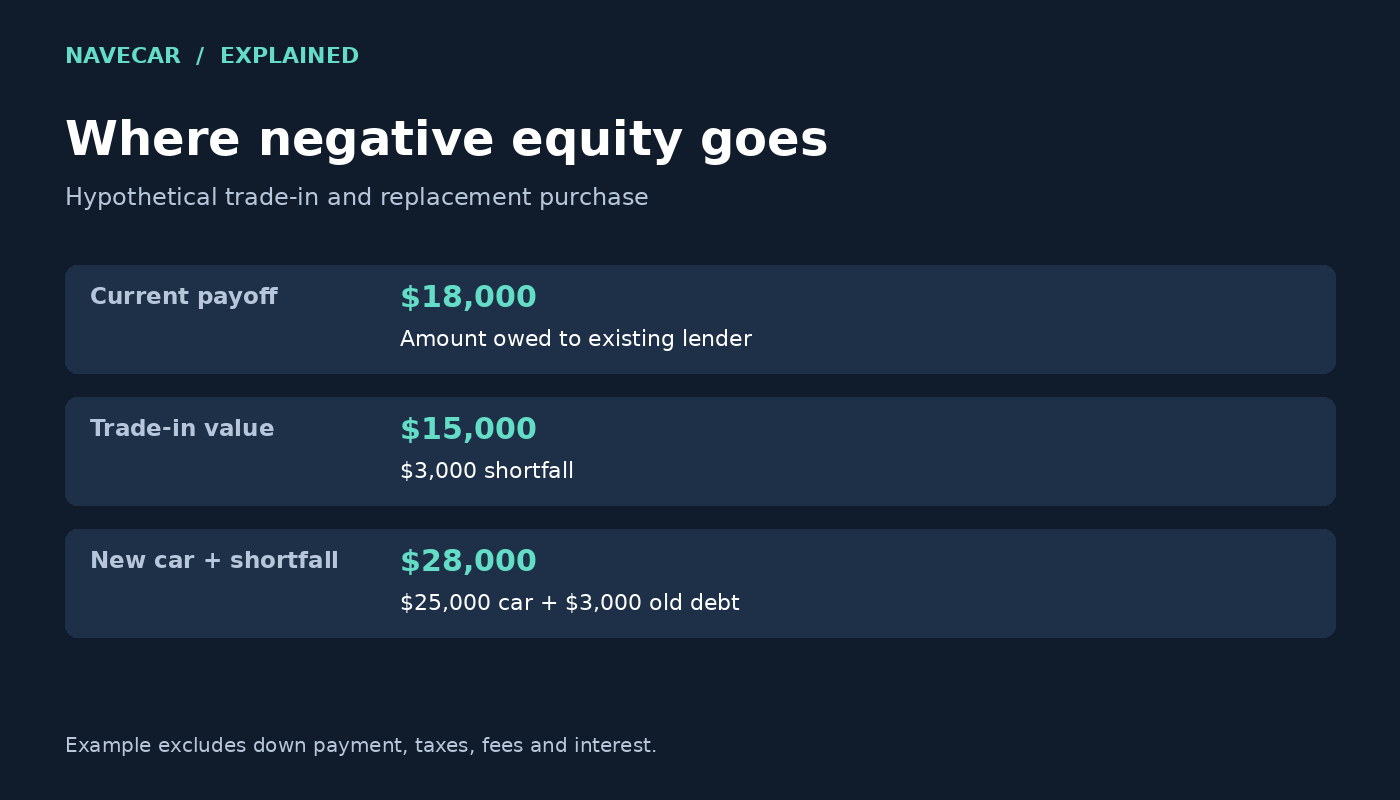
Assume your existing lender quotes an $18,000 payoff and a dealer offers $15,000 for the car. The difference is $3,000 in negative equity.
Advertisement
Now assume the replacement vehicle costs $25,000, before taxes and fees. With no cash down, adding the entire shortfall creates $28,000 of principal before other charges. You would be financing the replacement plus debt carried over from the previous car.
| Item | Hypothetical amount |
|---|---|
| Existing loan payoff | $18,000 |
| Trade-in allowance | $15,000 |
| Shortfall | $3,000 |
| Replacement vehicle price | $25,000 |
| Principal with shortfall added | $28,000 |
This is an arithmetic example, not a lender offer or approval estimate. It excludes taxes, title, registration, dealer charges, optional products and interest. No rate, term or monthly payment is assumed.
See what cash down actually changes
In this example, paying $3,000 in cash to cover the shortfall would leave $25,000 to finance before excluded charges. Putting down $1,000 instead would leave $27,000. Those figures show why the same advertised vehicle price can produce very different loan amounts.
Ask for an itemized worksheet showing the new car’s selling price, the trade allowance, the old payoff and your cash contribution as separate entries. A single monthly-payment number cannot tell you whether the dealer changed the car price, trade value, term or amount financed.
Confirm the old account was paid
A lender’s payoff quote may differ from a statement balance because of interest or other charges. The CFPB recommends contacting the old lender after the transaction to confirm payoff; its guidance suggests checking after one week.
Keep the payoff information and signed documents together. If the old account still shows a balance, resolve that with the parties handling the payoff rather than assuming a trade-in receipt proves completion.
Decide whether replacing the car is necessary now
Waiting, reducing the outstanding balance or choosing a less expensive replacement may change the borrowing needed. Compare those options using actual payoff quotes and vehicle offers. The CFPB’s affordability guidance also includes insurance, maintenance and fuel in the ownership budget. Covering the shortfall should not consume money needed for the rest of that budget.