A hybrid’s higher mpg figure can reduce gasoline spending, but the size of that saving depends on how far you drive and how much extra you pay for the vehicle. Compare dollars and gallons over the same mileage before deciding whether a price premium fits your plans.
The EPA’s guide to the gasoline fuel-economy label explains that annual fuel-cost estimates depend on assumed mileage and fuel prices. Your own comparison should use inputs relevant to your driving rather than automatically adopting the label’s assumptions.
Start with gallons, then calculate dollars
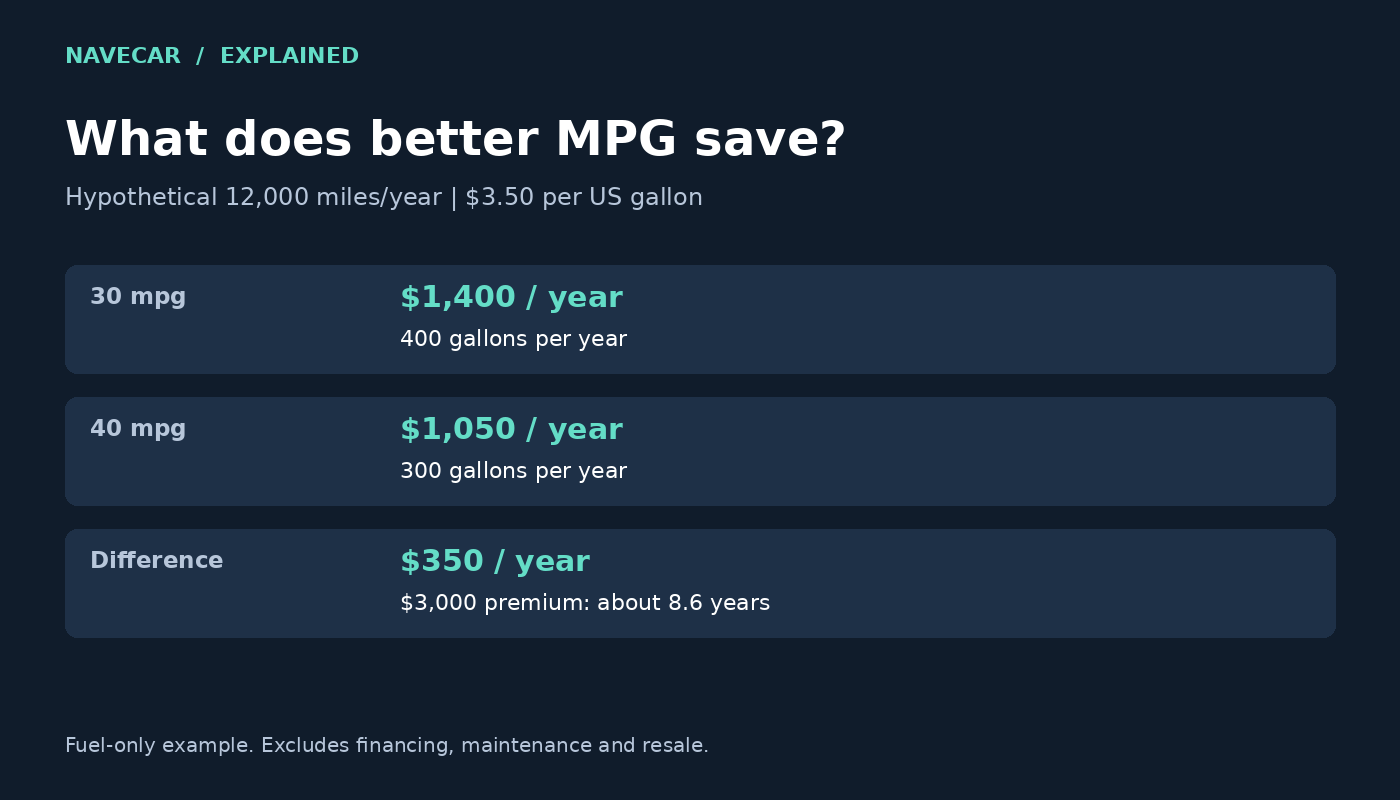
Consider two hypothetical gasoline-fueled vehicles: one achieves 30 mpg and the other 40 mpg. Assume 12,000 miles per year and gasoline at $3.50 per US gallon. These are illustrative inputs, not specifications or price forecasts for a particular model.
Advertisement
Annual gallons equal miles divided by mpg. Annual fuel cost equals gallons multiplied by the price per gallon.
| Assumption or result | 30-mpg vehicle | 40-mpg vehicle |
|---|---|---|
| Annual driving | 12,000 miles | 12,000 miles |
| Fuel used | 400 US gallons | 300 US gallons |
| Annual gasoline cost | $1,400 | $1,050 |
The difference is 100 gallons, or $350 a year. If the more efficient vehicle costs $3,000 extra, dividing that premium by $350 gives a simple fuel-only break-even time of about 8.6 years.
Mileage can change that result substantially
At 18,000 annual miles with the same mpg and gasoline price, the vehicles use 600 and 450 gallons. The $525 annual difference reduces the $3,000 fuel-only payback period to about 5.7 years.
At 6,000 miles, the difference falls to 50 gallons, or $175 a year, and the corresponding period rises to about 17.1 years. These calculations hold all other inputs constant to show the effect of mileage alone.
That is why a high-mileage commuter and someone using a car mainly for short weekly errands can reach different purchase decisions from the same efficiency ratings.
Match the cars before calling it a hybrid premium
Use actual quotes for comparable grades, equipment and drive configurations. If the hybrid also includes AWD or additional convenience equipment, the entire price gap cannot be attributed to fuel-saving technology alone.
This calculation excludes financing, taxes, insurance, maintenance, repair costs and resale value, as well as the time value of money. Include those separately when assessing the full ownership cost. A fuel-only payback period is one part of that decision.
Finally, use comparable fuel-economy measures. EPA distinguishes mpg from MPGe, which expresses energy equivalence for other fuels. A plug-in vehicle requires electricity costs and charging assumptions as well as gasoline use; the gasoline-only arithmetic above is insufficient for that comparison.