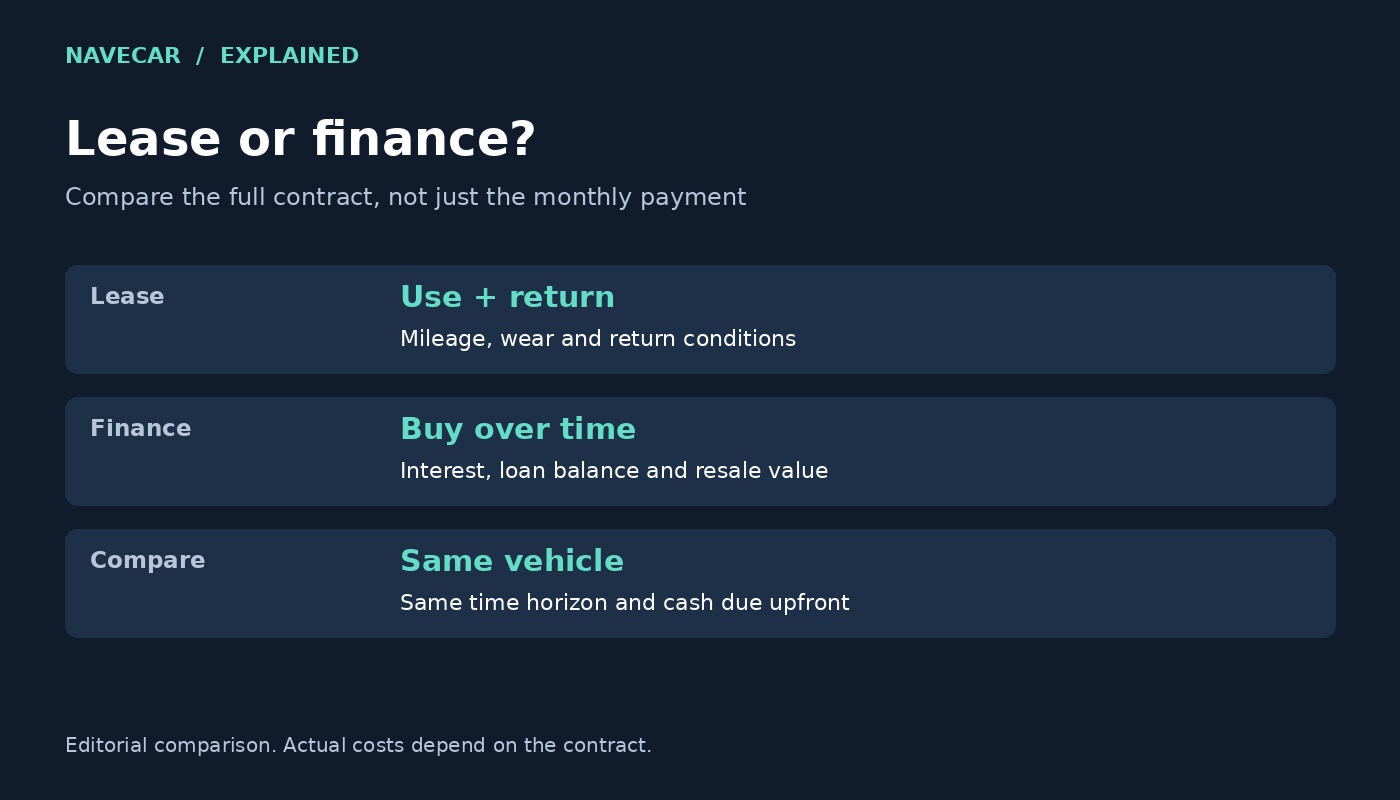
A lower lease payment does not, by itself, show that leasing costs less than buying. A useful comparison starts with the same vehicle, the same period of use and a clear account of what you own—or owe—at the end.
The FTC explains that lease payments cover use of the car, including expected depreciation, a rent charge, taxes and fees. Loan payments repay a purchase plus financing costs. These arrangements leave you in different positions when the scheduled payments stop.
Put the contracts side by side
| Question | Lease | Purchase financed with a loan |
|---|---|---|
| What happens at the end? | Return the vehicle, or use a purchase option if the contract permits | Keep the vehicle after repaying the loan |
| What limits should you inspect? | Mileage allowance, excess wear and early termination | Loan terms, payoff balance and any prepayment terms |
| What value remains? | Depends on any purchase option you exercise | Vehicle’s market value, less any remaining loan balance |
The National Automobile Dealers Association’s consumer checklist distinguishes the fixed use period of a lease from buying and keeping a car. It also points shoppers toward insurance, fuel and maintenance costs when assessing affordability.
Advertisement
Count cash due at signing correctly
For a hypothetical lease—not an advertised offer—assume $3,000 due at signing includes the first of 36 monthly payments of $350. Scheduled cash paid is then $3,000 plus 35 payments, or $15,250. Adding all 36 payments to the upfront amount would count the first one twice.
That subtotal excludes any other charges not included in the stated assumptions. The actual agreement may have different taxes, acquisition charges, return fees or deposits. Read its itemization rather than treating this example as a market price.
For a loan comparison, list the down payment and payments made during those same 36 months. Then account for the car’s value and the remaining payoff balance. A six-year loan is not fully repaid just because the comparison ends after three years.
Match the agreement to your mileage and plans
The FTC warns that leases can impose charges for excess mileage, wear or early termination. Estimate your driving from commute distance and recurring trips, then compare it with the written allowance. Check the per-mile overage charge and ask how damage is assessed at return.
Leasing can suit someone whose expected use fits a defined contract period. Buying offers a different path for someone planning to keep the car after the loan ends. Neither is automatically cheaper: the result depends on actual quotes, length of ownership, mileage and remaining value. Keep those inputs visible before choosing on payment alone.