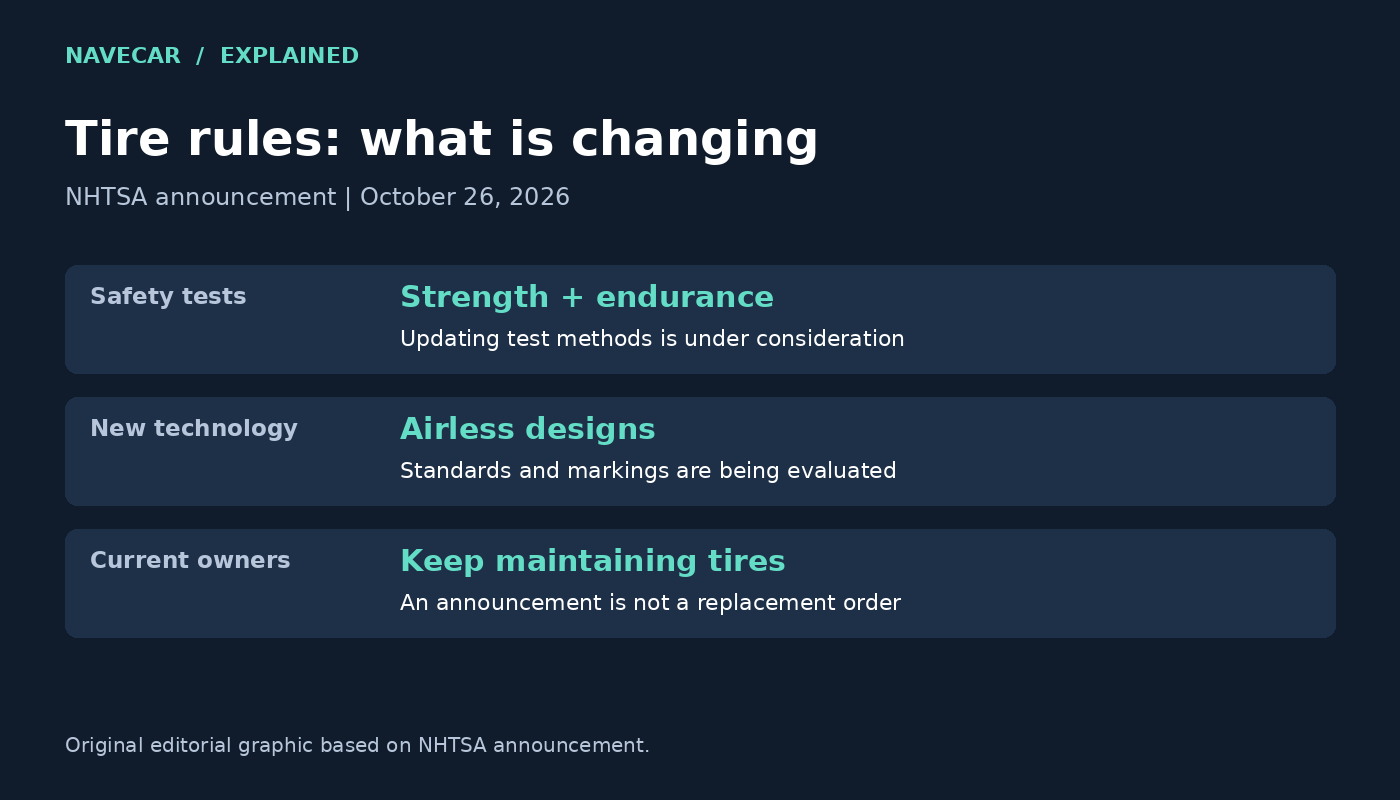
NHTSA announced on October 26 that it is moving to modernize federal tire safety standards, including test methods and the treatment of newer designs. The announcement outlines a rulemaking process, rather than a completed set of new requirements for drivers.
The agency says areas under consideration include strength, rim-resistance and endurance tests; airless tire technology; sidewall markings; and weight-limit guidelines for trucks and SUVs. It plans a negotiated rulemaking involving up to 18 stakeholders from industry, safety organizations, research and engineering.
A standards project is different from a recall
The October announcement does not identify a defective tire model or tell owners to replace an existing set. Nor does it establish that airless tires are now approved for every passenger vehicle. Its focus is the framework used to evaluate tire safety.
Advertisement
NHTSA presents improved safety and lower costs as objectives of the modernization effort. The announcement provides no model-specific retail savings or guaranteed price reduction for the next set of tires a driver buys.
That distinction is useful when reading headlines about new standards. A proposal, an advisory process and a final enforceable requirement are different stages. Owners looking for an immediate purchasing decision still need information about the tire and vehicle in front of them.
What to check on the tires you use now
NHTSA’s separate TireWise guidance recommends checking pressure at least monthly when tires are cold—after the vehicle has not been driven for at least three hours. Use the vehicle’s door-area placard or owner’s manual for the recommended pressure, rather than the pressure printed on the tire sidewall.
Also examine tread and visible damage. NHTSA identifies 2/32 inch as a worn-out tread depth requiring replacement. Its guidance says a tire-pressure warning system does not replace regular checks with an accurate gauge.
Match replacements to the vehicle and conditions
Before buying, write down the vehicle’s specified tire size and the specifications of the replacement being quoted. Ask the seller to explain any proposed change from the manufacturer’s recommendation. Keep the tire model on the estimate so different quotes can be compared directly.
The forthcoming standards discussion does not remove the need to choose tires suited to the vehicle and driving conditions. It also does not provide a universal rotation or replacement interval: follow the applicable vehicle and tire instructions. For an owner, the immediate task remains maintaining the current set and resolving any damage or persistent pressure loss.